Skip to content
Stitch

Basket Weave Stitch

Learn the Basket Weave Stitch, a richly textured crochet stitch made by alternating groups of front post and back post double crochet.

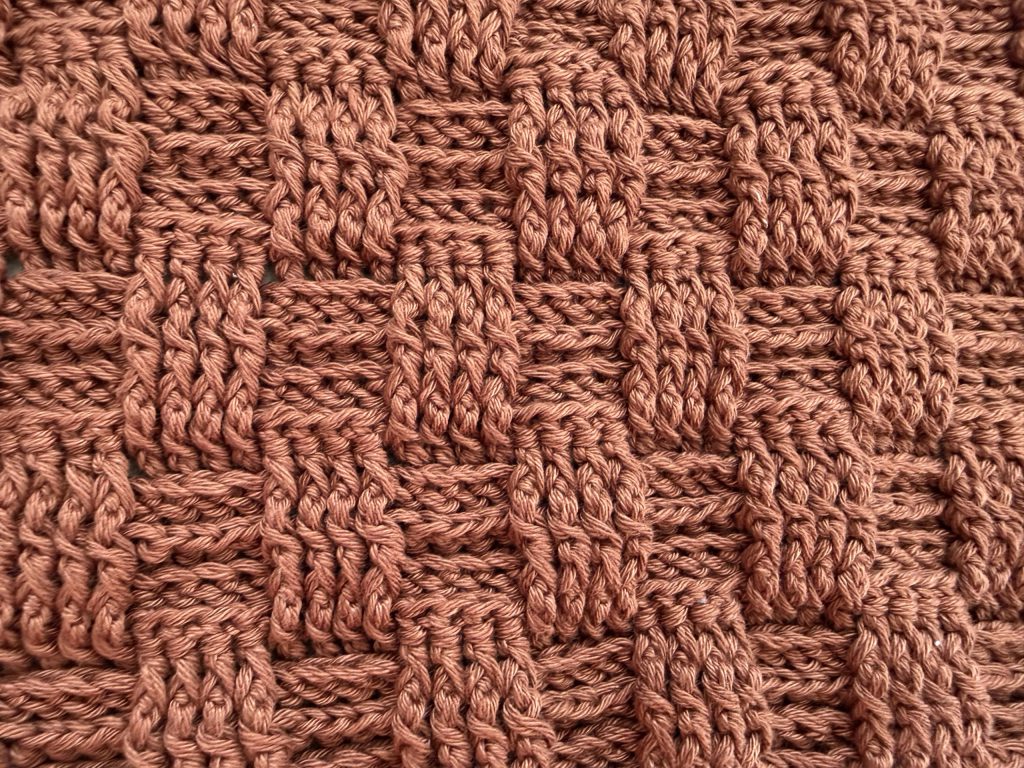
Close-up of the textured Basket Weave crochet stitch

Basket Weave Stitch creates a woven, checkerboard-style fabric using front post double crochet and back post double crochet stitches. Alternating groups of post stitches changes which sections sit forward and which sit back, creating the raised basket effect.

This version uses groups of four stitches. Work 4 front post double crochet (FPDC) followed by 4 back post double crochet (BPDC) across the row. Keep the same arrangement for four rows, then reverse the groups for the next four rows. Together, those eight rows create the full Basket Weave pattern.

In my video’s setup, use a multiple of 8 + 2 foundation double crochet stitches, or a starting chain of 8n + 4 when using the chain-start method. These are different counts: the extra starting chains provide the first row’s height. My larger Basket Weave sample was made with 74 foundation double crochet stitches.

Keep one ordinary double crochet at each edge. The 74-stitch sample therefore has 72 post-stitch positions between its two edge stitches. The groups of four are worked across that middle section, not through the edge stitches.

At the beginning of each row, chain 2 and turn. The chain 2 does not count as a stitch, so work into the first stitch as normal.

Planning your own project?
Use the Crochet Stitch Helper to work out a starting stitch count for Basket Weave and see how the stitch repeat fits your project.

Basket Weave is a great choice when you want a crochet fabric with plenty of structure and dimension. It works especially well for projects like dishcloths, towels, blankets, scarves, and other pieces where you want the stitch pattern to stand out.

For the complete row-by-row instructions, see How to Crochet the Basket Weave Stitch.
Learn crochet, one skill at a time

New to crochet? Begin with the first path. Already making stitches? Choose the skill you need today. These written lessons use US crochet terms. Follow a path in order, or open its lesson list to choose your next step.

1. Make your first stitches

Start here if you are new. Make a chain and a small swatch, then learn to read its stitches and edges.

Start this path
See all 8 lessons
  1. How to Hold Your Crochet Hook and YarnFind a comfortable grip and let the yarn feed smoothly.
  2. How to Make a Slip Knot and Crochet a Foundation ChainMake and count a starting chain you can work into.
  3. How to Crochet Your First Single Crochet SwatchMake a small swatch and practise single crochet, turning, and counting stitches.
  4. How to Half Double Crochet: Your First RowsPractise 10 half double crochet stitches across each row.
  5. How to Double Crochet: Your First RowsLearn double crochet with a counted chain-three edge.
  6. How to Count Crochet Stitches and RowsRecognize stitch tops and count completed rows.
  7. Crochet Turning Chains: When Do They Count as a Stitch?Know when a turning chain replaces a stitch.
  8. How to Keep Your Crochet Edges StraightFind your edge stitches and work out why a row is growing or shrinking.

2. Explore loops, shaping and rounds

Once the basic stitches feel familiar, change the insertion point, shape a row and practise joining rounds.

Start this path
See all 6 lessons
  1. Front Loop and Back Loop Crochet: Where to Insert Your HookChoose the near or far strand without adding a stitch.
  2. How to Find and Crochet into the Third Loop of HDCFind the extra HDC bar in turned rows and unturned rounds.
  3. Right Side and Wrong Side in Crochet: How to Keep TrackKeep track of the face your pattern calls the right side.
  4. How to Increase and Decrease in Single CrochetSee how two-in-one and sc2tog change the count.
  5. Crochet Rows, Joined Rounds, and Spirals: What Changes?Understand what changes when you turn, join or work a spiral.
  6. How to Join Crochet Rounds with a Slip StitchPractise a 12-stitch tube and recognize its round boundary.

3. Fix and finish your crochet

Learn how to undo a mistake, change color, secure the tails, sew a seam and care for the finished fabric.

Start this path
See all 5 lessons
  1. How to Fix Crochet Mistakes Without Losing Your PlaceUndo the mistaken stitch and recover a complete live loop.
  2. How to Change Yarn Colors in CrochetChange the working strand on the final pull-through.
  3. How to Fasten Off Crochet and Weave in the EndsClose the live loop and practise a relaxed weaving route.
  4. How to Join Crochet Pieces with a Simple Sewn SeamMatch two top edges and follow a both-loop whipstitch.
  5. How to Block Crochet Without Stretching It Out of ShapeCare for and shape a sample without forcing its size.

4. Choose supplies and plan a project

Read yarn labels and patterns, measure gauge and plan size and yarn needs. Visit the first two lessons here before buying supplies.

Start this path
See all 10 lessons
  1. How to Read a Yarn Label and Understand Yarn WeightSeparate yarn thickness from ball weight and yardage.
  2. How to Choose a Crochet Hook SizeChoose a starting hook and adjust it using gauge.
  3. How to Read a Crochet PatternUnderstand US abbreviations, repeats, stitch counts, and row instructions.
  4. How to Measure Crochet GaugeCount stitches and rows to understand how your fabric affects project size.
  5. How to Substitute Yarn in a Crochet PatternCompare fiber, fabric, care and the length you need.
  6. How to Estimate Yarn for a Crochet ProjectEstimate a rectangle’s yarn use from a measured sample.
  7. How to Make a Flat Crochet Project Wider or NarrowerUse gauge and stitch repeats to plan a simple rectangle.
  8. How to Choose a Crochet Pattern Size and Plan Simple ChangesCompare body measurements, finished size and ease.
  9. How to Choose a Crochet Stitch for Your ProjectChoose fabric for coverage, flexibility and construction.
  10. How to Choose Crochet Stitches for Kitchen TowelsCompare textures before choosing a towel pattern to try.

Prefer browsing? Explore the stitch library or all tutorials.